
Interoperability: They ensure compatibility among various electric vehicle (EV) charging infrastructure providers, allowing diverse EVs to use the same ev charging stations and seamlessly integrating different hardware and software systems.
Communication and Data Exchange: They enhance coordination among participants by building communication infrastructures and securely and efficiently exchanging critical information, including billing details, user credentials, and technical instructions.
Seamless Transactions: They streamline payment processes for electric vehicle drivers, facilitating quick and easy transactions during charging.
Monitoring: They monitor key parameters during the charging process to mitigate risks and facilitate communication and data exchange between electric vehicles, electric car charging stations, and central or energy management systems.
Smart Charging: They dynamically adjust based on grid capacity and electricity costs, optimizing the charging process for electric vehicles and improving energy efficiency.
Plug-and-Play Charging: They feature automatic charging commencement when the vehicle is connected to a ev charger, providing greater convenience and reducing wasted time.
Safety: They enforce safety standards, addressing physical and cybersecurity issues to protect vehicles, passengers, and data from potential harm.
Central System – Electric Vehicle Charger Protocol
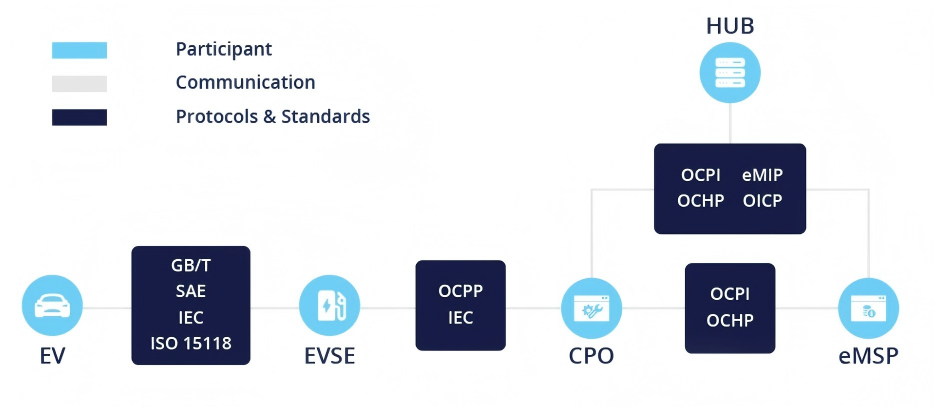
These standards and protocols cover communication between the central electric vehicle charging system and electric vehicle charging stations, primarily for infrastructure monitoring and management.
Communication Examples (Central System – Charging Station):
a) One party makes an operation request (e.g., start charging), and the other party acknowledges or refuses;
b) One party informs the other party of its status (e.g., connector is available for charging);
c) One party sends a billing summary to the other party (e.g., CPO sends a summary to eMSP);
OCPP
The Open Charging Point Protocol (OCPP) is a communication protocol for electric vehicle charging between charging piles and central management systems. It is a free-to-use protocol widely adopted by numerous vendors worldwide.
It is developed by the Open Charging Alliance (OCA) and has become an essential standard for ensuring interoperability between electric vehicle charging manufacturers, charging network operators, and software vendors.
Energy Management and Distribution Agreement
These standards optimize electric vehicle charging, enabling energy distribution in a highly efficient and energy-saving manner without overloading the power grid, thereby facilitating electric vehicle charging.
OSCP
The Open Smart Charging Protocol (OSCP) is a standard designed to optimize electric vehicle charging by managing the distribution of power between the power grid and charging stations.
This protocol ensures efficient energy use, especially during peak demand periods, through effective communication between the DSO (Distributed Electricity Storage System) and CPO (Consumer Point of Purchase). Given its significant advantages and sustainability, this protocol represents the future of the industry.
Electric Vehicle Charging Roaming Protocols
These roaming protocols define various operations between the CPO and the EMSP. The most common examples include: searching for electric car chargers from other operators, driver authorization, session management, etc.
IEC 61851
IEC 61851 specifies the international requirements for conductive charging systems for electric vehicles.
This standard is divided into several parts, each covering different aspects: general system requirements, connector types, and testing and certification standards. This protocol falls under the category of central systems—electric vehicle charging protocols and roaming protocols. Its multi-part structure and coverage of various areas make it particularly noteworthy. Each part addresses different aspects: general system requirements, connector types, and testing and certification standards.
Post time: Dec-24-2025


