
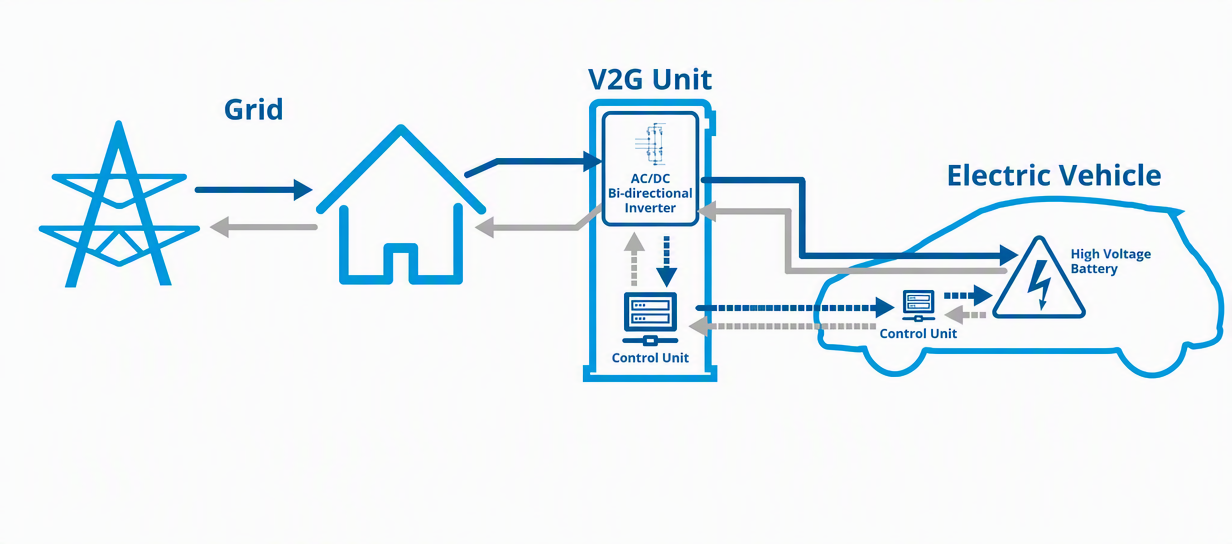
The electric vehicle charging architecture diagram illustrates the architecture and relevant standards of electric vehicle charging systems.
Electric vehicles and electric vehicle supply equipment (EVSE) are the primary participants in the charging process. An electric vehicle connects physically to the EVSE via a charging cable. They communicate using two standards: IEC 61851 for low-level communication and ISO/IEC 15118 for high-level communication. Specifically, the Electric Vehicle Communication Controller (EVCC) within the vehicle and the Supply Equipment Communication Controller (SECC) within the EVSE handle high-level communication to manage the entire charging process.
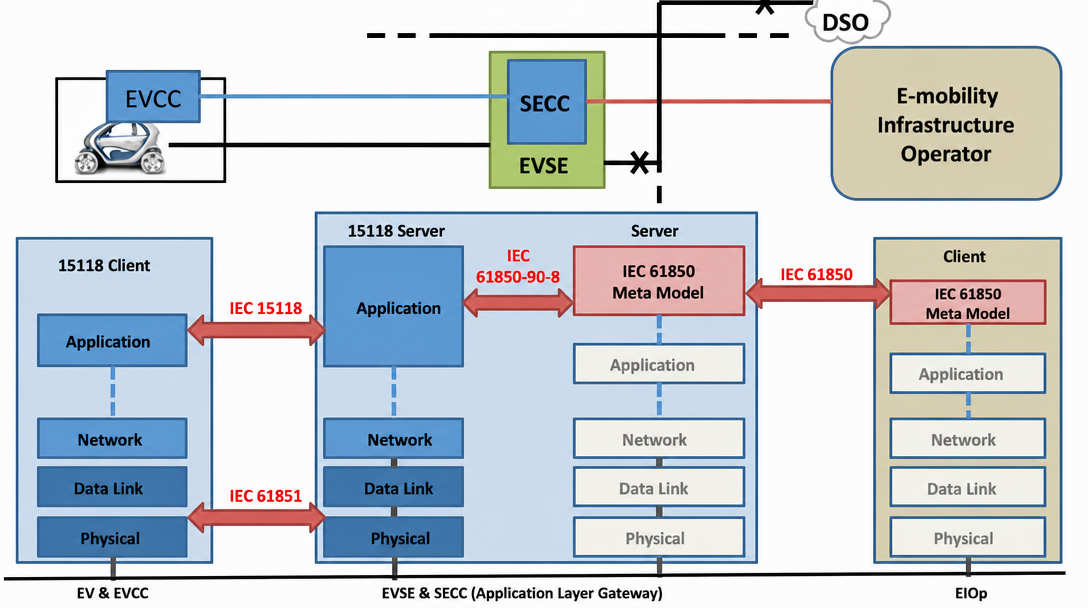
At the other end of the charging station, secondary participants play supporting roles, such as billing and power control. In this work, we focus on a secondary participant known as the “Operator,” which participates in the charging process by handling power-related values.
15118 Client
(Corresponds to EV & EVCC): Comprises four layers—Application, Network, Data Link, and Physical.
15118 Server
(Corresponds to EVSE & SECC): Features the same four-layer structure and communicates with the Client on the left via the IEC 15118 protocol; the IEC 61850-90-8 standard is also indicated between the application layers.
Located in the middle and labeled as “Application Layer Gateway”; the application layer utilizes the IEC 61850 meta-model, and it also comprises the four layers: Application, Network, Data Link, and Physical.
(Corresponds to EIOp): Communicates with the third column via the IEC 61850 protocol; features a symmetrical structure.
Post time: Sep-22-2026


